
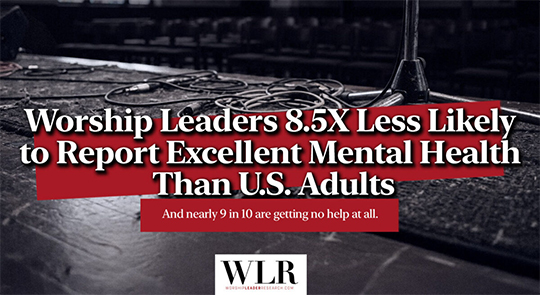
Last week, I saw this article across my newsfeed on social media. As someone who trains worship leaders, this headline certainly grabbed my attention. Having only worship leaders report their mental health as only in the single digits is concerning, and having the general public be 8.5 times more likely to report excellent mental health is as well. This is something that we, as a group of worship leaders, should pay attention to. I will not recap the article in its entirety, but here are a few observations.
There were some encouraging signs as well. The data shows we are much less likely than the general public to experience “severe or acute distress symptoms.” The authors note: “Worship Leaders are, as a group, not in crisis. But they are certainly not thriving.”
The section on “Purpose Paradox” was very interesting. 78% of respondents found purpose in their work, compared with only 18% of the general population. However, only 44% reported “frequent joy or contentment” in their role.
While millennials and Gen Z as a whole are more likely to seek help and counseling, the authors conclude that “..it seems younger Worship Leaders are, at once, less likely to seek outside help and less likely to feel supported from within the walls of the church.” We should make sure to support and encourage the next generation.

Recent Comments