
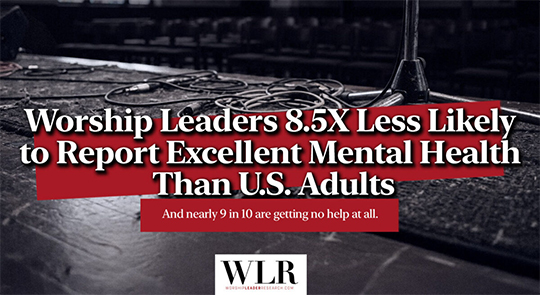
Last week, I saw this article across my newsfeed on social media. As someone who trains worship leaders, this headline certainly grabbed my attention. Having only worship leaders report their mental health as only in the single digits is concerning, and having the general public be 8.5 times more likely to report excellent mental health is as well. This is something that we, as a group of worship leaders, should pay attention to. I will not recap the article in its entirety, but here are a few observations.
There were some encouraging signs as well. The data shows we are much less likely than the general public to experience “severe or acute distress symptoms.” The authors note: “Worship Leaders are, as a group, not in crisis. But they are certainly not thriving.”
The section on “Purpose Paradox” was very interesting. 78% of respondents found purpose in their work, compared with only 18% of the general population. However, only 44% reported “frequent joy or contentment” in their role.
While millennials and Gen Z as a whole are more likely to seek help and counseling, the authors conclude that “..it seems younger Worship Leaders are, at once, less likely to seek outside help and less likely to feel supported from within the walls of the church.” We should make sure to support and encourage the next generation.

I thought the article was very interesting! It’s sad to hear that it’s common among worship leaders to struggle with mental health. I also thought it was interesting that the author of the article thinks that maybe having more comprehensive mental health support within the church may be beneficial. I certainly think that would help in many ways.
I think this is something that we should really pay attention to as we seek to serve in churches. In my experience, it always seems like such a shocker when someone admits to having genuine mental health struggles. It’s such a hidden struggle. It seems like it is a battle that is very closely woven together with the lie from the devil that no one else feels the same way that you do. A mentor told me once that it is important to always have someone to minister to, someone to be your peer, and someone to minister to you. I think a potential cause for this issue is that it may be difficult for worship leaders to find that person who ministers to them. They may feel that it is their responsibility to always be willing to minister to others and it can be very challenging when they don’t have someone wiser and more experienced than them to go to when questions arise. I could be totally off with that thought, but it’s just the first thing that came to mind and I think it could be something to consider that could be related to this issue.
This article definitely brought the issue of mental health to my attention, and it’s something that I will try to be more aware of from now on. I think in today’s culture, we don’t often admit if we are having mental health struggles, and we tend to just keep it to ourselves. When I try to see what the cause of this may be, I think part of it could be all the unseen pressure that a worship leader has on them. People, either in the church staff or in the congregation, will always be critical or have their own opinions. I know it can be hard not to fall into the trap of trying to please everyone and put that on yourself. I also think that it’s very important to make sure your peers and other church staff are with you and supporting you. One of the reasons why I think worship leaders’ mental health is so low is that a lot of the time, they may feel alone and isolated. Overall, those are just a few reasons why I think mental health is lower compared to others.
Mental health within the church and among its leaders is slowly but surely becoming more prevalent. I hope it continues to become more and more normalized and discussed, as burnout among pastoral and ministry workers is only increasing. When thinking about it, it does make sense as they are consistently hearing comments about them, their music choices, and so many other things that can weigh on their minds and affect their mental health. Even people who lead and steward others need people to do the same for them, or they become people who are so much of themselves in others until they become empty. Overall, I think this article and topic is important to anyone, as it reminds them to check on those who serve within churches, or to those who do serve to check in on their individual spiritual, mental, and physical health.
This really stood out to me because it’s kind of shocking that worship leaders can feel such a strong sense of purpose but still not experience much joy. That gap makes it seem like a lot of people in ministry might be burned out or just not being cared for themselves. The idea that we’re “not in crisis but not thriving” feels pretty common, especially when there’s pressure to always be spiritually strong. The part about younger worship leaders struggling more and feeling unsupported is honestly the most concerning, because it shows something is off in how we’re discipling and encouraging the next generation. Overall, it feels like a wake-up call that we need to take mental and spiritual health seriously if we’re going to lead others well.
This is honestly a sobering reflection, and I’m glad you brought attention to it instead of just letting it pass by. The “purpose paradox” you mentioned really stands out to me, because it captures something a lot of worship leaders probably feel but don’t always articulate. Having a strong sense of calling but not experiencing consistent joy is a tough place to live. It suggests that purpose alone isn’t enough to sustain someone emotionally or spiritually, especially in a role that is both visible and often pressure-filled.
I also think your point about younger worship leaders is really important. It’s concerning that they’re less likely to seek help and also feel less supported within the church, because that creates a gap where struggles can go unnoticed. If churches don’t intentionally create space for encouragement, mentorship, and honest conversation, that tension will only grow. Like you said, this isn’t a group in crisis, but it’s clearly a group that needs more care. If worship leaders are helping lead others spiritually, there has to be a structure in place to support them as well, not just in their role, but as people.